OOP - Using classes and objects
Posted under » Methodology on 13 March 2009
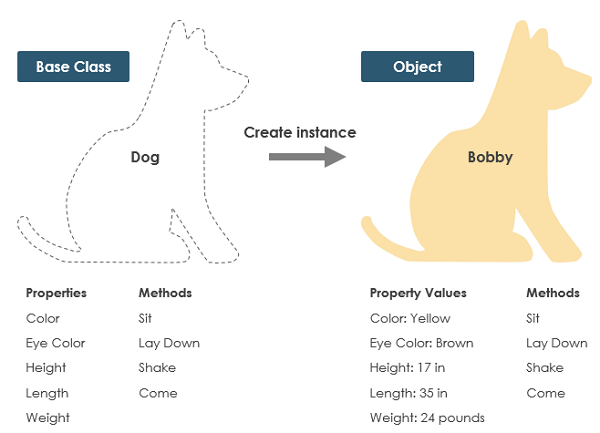
As implied by the name, the central concept of OOP is the object. At a practical level, an object is simply a data structure comprised of functions and variables local to each object. The class from which the object is created defines what an object can do. An application can create many objects based on a single class definition. In OOP jargon, an object is an instance of a class, and the act of creating an object from a class is called instantiation.
The objects should be identified with responsibilities.
Class
The fundamental building block of all object-oriented code is called a class. This is simply a collection of related variables and functions, all wrapped up in a pair of curly braces and labeled with the name of the class. A class is the code that defines the functions and variables an object created from the class will have. The class definitions can be thought of as templates from which objects are created.
In OOP-speak :
Framework and class library
Most programming languages have class already built. These are called framework. For example, Java comes with Java class library.
Objects properties
PHP has two kinds of scope; local and global. With objects, you get a third kind of scope, which is the objects properties. A major difference from procedural programming is that the properties and methods of an object can be declared protected or private. You can think of it as a kind of extended local variable. In general, global variables are bad practise, because of the (implicit) dependencies they introduce. Object properties doesn't have these problems, and this is one of the key benefits of object oriented programming.